
Key Facts:
- Oracle CPQ is strongest when quoting sits close to Oracle commercial operations.
- Salesforce has the clearer public pricing story and appears slightly easier to adopt for many CRM-native teams.
- Oracle often rewards teams that need deeper control over pricing and commercial rules.
- A move from legacy Salesforce CPQ into the newer Salesforce revenue architecture is not a simple data transfer.
Oracle and Salesforce both solve the same core problem: helping revenue teams sell complex products without getting lost in spreadsheets, manual pricing exceptions, or slow approval chains. The difference is where each platform puts its center of gravity.
What Is a CPQ Platform?
A CPQ platform is software that helps sales teams configure products correctly, apply the right pricing and discounts, generate accurate quotes, and move those quotes toward order capture without breaking margin rules or policy. In simple terms, CPQ acts like the rulebook and calculator behind enterprise selling.
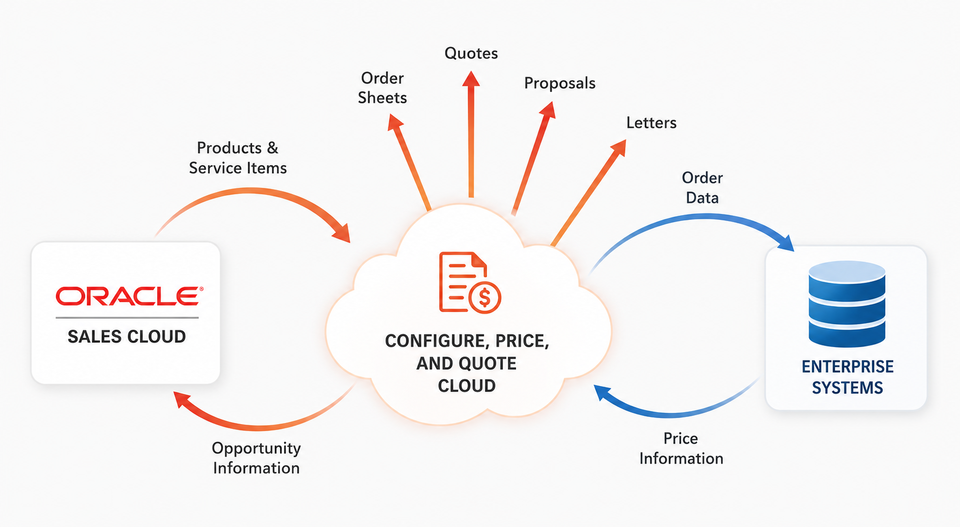
What Is Oracle CPQ?
Oracle CPQ is Oracle’s cloud-based CPQ application for helping sellers configure the right mix of products or services and generate accurate professional quotes.
Pros and cons
Pros. Oracle’s strengths are easiest to see in complex enterprise scenarios. Its public product materials emphasize reusable product models, AI-driven suggestions, multi-book and channel pricing, deal scoring, discount optimization, mobile-first approvals, recurring subscription support, and self-service selling across direct, indirect, and ecommerce channels.
Cons. Oracle’s flexibility comes with a heavier administration model. Oracle’s Redwood admin experience now consolidates navigation for products, prices, configurations, data tables, integrations, migration tooling, development tools, and UI settings, which is excellent for control but signals a platform that still expects disciplined administration.
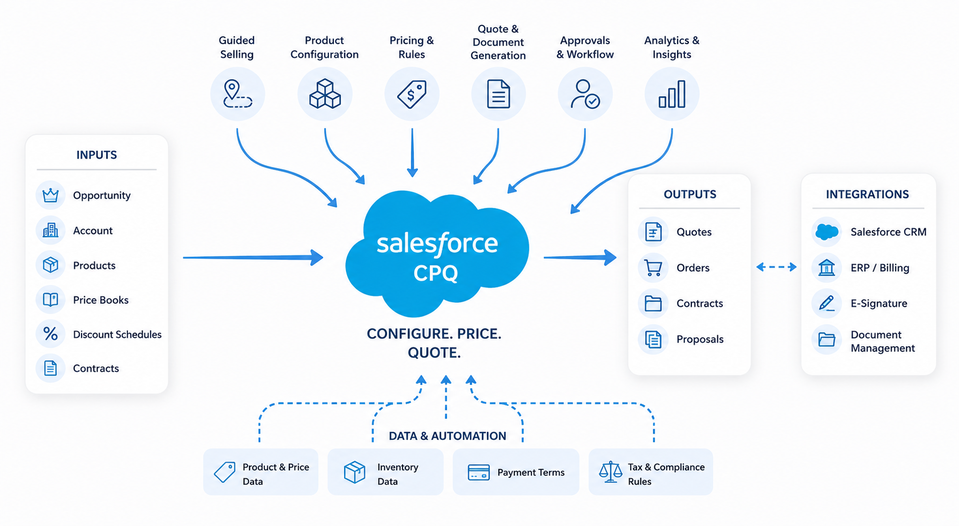
What Is Salesforce CPQ?
For enterprise buyers in 2026, “Salesforce CPQ” now covers two related realities. There is still a large installed base and documentation footprint for Salesforce CPQ, but Salesforce’s current strategic revenue platform is branded Agentforce Revenue Management, formerly Revenue Cloud.
Pros and cons
Pros. Salesforce’s biggest advantage is native fit for companies already centered on Salesforce CRM. The current product story combines CPQ, centralized product catalog and pricing, order capture, subscriptions, contracts, invoicing, self-service channels, partner selling, field workflows, APIs, and AI inside the same platform family.
Cons. The challenge is roadmap complexity, not lack of capability. Salesforce is clearly steering buyers toward Agentforce Revenue Management and a newer product-to-cash architecture, and its own migration guidance says moving from Salesforce CPQ to that newer model is more than a data exercise.
Oracle CPQ vs. Salesforce CPQ: Core Feature Comparison
| Capability | Oracle CPQ | Salesforce CPQ |
| Product configuration and guided selling | Guided pathways, reusable product models, AI suggestions, self-service co-configuration, subscription, and service ordering | Guided selling flows, attribute-based catalog, rules-based and constraint-based configurator, reusable templates |
| Pricing management and discount governance | Multiple price books, promotions, localization, channel pricing, multitier pricing, price scoring, deal context, automated approvals | Configurable pricing engine, visible calculation logic, volume/compound/proportional discounts, workflow-driven approval chains |
| Quote generation and proposal automation | Branded quote and proposal generation, real-time pricing on quotes, document APIs, and commerce portal proposal sharing | Dynamic quote documents, templates, quote document APIs, PDF generation, AI quote creation/modification/summarization |
| Approval workflows and sales automation | Dynamic routing, workflow approvals, smart notifications, mobile-first approvals | Advanced Approvals, serial/parallel chains, Flow-based orchestration, and role-based access in the quote lifecycle |
User Experience and Ease of Adoption
For many enterprises, the ease of adoption of technologies is just as important as the benefits these techs can bring.
Interface and navigation
- Salesforce currently has the more familiar seller-facing message. Its CPQ page explicitly promises a spreadsheet-like UI and guided selling, which fits the expectations of sales teams already working inside Salesforce.
- Oracle is actively modernizing. Oracle’s 26A readiness materials introduced the Redwood-style Administration UX, with improved navigation, consolidated views, simplified design, and a stated goal of reducing training time.
Admin flexibility and customization
- Oracle gives administrators a lot of control. The current admin model spans products, configuration dashboards, pricing portals, commerce rules, integrations, data tables, development tools, logs, migration center, and UI settings.
- Salesforce gives admins flexibility through a more platform-familiar model. Salesforce documents point-and-click or code-based configuration approaches, Product Discovery and billing APIs, custom LWC-based third-party configurator components, Lightning Message Service integration, and workflow extensions through the broader Salesforce platform.
Learning curve for sales teams
For sellers, both platforms can feel much simpler than manual quoting once the rules are in place. Oracle reviewers on G2 explicitly say that once configured, Oracle CPQ is simple to use and strong for precise pricing and quoting.
Salesforce tends to feel faster for CRM-native reps, but it is not effortless. User-review snippets still mention a learning curve, especially when teams move beyond basic CPQ into broader product-to-cash and revenue-management workflows.
Integration Ecosystem and CRM Compatibility
For most enterprises, the real value of a CPQ platform depends not only on its quoting capabilities but also on how effectively it connects with CRM, ERP, billing, ecommerce, and other business systems.
Oracle CPQ integration capabilities
Oracle documents integration with Oracle Sales, Oracle Commerce, Oracle Subscription Management, Oracle Order Management, and Oracle Integration through the Oracle CPQ Adapter. Oracle also explicitly states that Oracle CPQ can integrate with any CRM solution, including Salesforce Sales Cloud.
Salesforce CPQ integration capabilities
When opportunities, accounts, activities, approvals, service work, and partner processes already live in Salesforce, CPQ does not have to bridge as many user-context gaps. Salesforce’s newer revenue architecture also leans heavily into APIs, with public documentation for Product Discovery APIs, billing APIs, usage APIs, and native business APIs across product-to-cash operations.
ERP, billing, and ecommerce connectivity
- Oracle’s back-end alignment is one of its strongest enterprise arguments. Oracle Commerce can call Oracle CPQ for complex ecommerce configuration, Oracle Order Management can orchestrate the resulting orders, and Oracle Subscription Management handles subscription and usage-based lifecycle scenarios.
- Salesforce’s connectivity story is broader across CRM-led channels. Salesforce positions Revenue Cloud Billing as flexible with ERP systems, supports billing inside the revenue stack, and ties CPQ into self-service channels, partner selling, field service, and B2B Commerce interoperability.
Implementation Complexity and Time-to-Value
To make the right choice, Oracle CPQ vs. Salesforce CPQ, it’s important to carefully analyze how complicated it would be to implement either of these technologies and how quickly you can reap the benefits:
Oracle CPQ implementation considerations
The platform gives teams migration package APIs, migration-task APIs, a CLI-based developer toolkit, data-table import/export support, and additional test-environment options.
Salesforce CPQ implementation considerations
Salesforce’s implementation guidance is more explicitly phased. Salesforce says teams should gather requirements, sequence feature deployment, set project milestones, import data, and work closely with business users.
Migration and data synchronization challenges
- Salesforce’s migration guidance is unusually clear that moving from Salesforce CPQ to the newer Revenue Management model is not just a record export and import. Product catalog migration is described as an architectural evolution, and quotes can require header- and line-level reconciliation.
- Oracle’s challenge shows up in a different way. Oracle has had to improve how CPQ maps external product identifiers when synchronizing both Fusion and Salesforce product structures, and Oracle has also announced the deprecation of one near-real-time synchronization mode in favor of batch synchronization for product sync.
AI, Automation, and Advanced Revenue Operations Features
Artificial intelligence is becoming a major differentiator in modern CPQ platforms, extending beyond quote generation to influence pricing decisions, approval processes, and revenue forecasting.
AI-assisted recommendations and guided selling
- Oracle has added a substantial amount of AI to CPQ over the last several releases. Official readiness materials list AI-generated product recommendations, an AI-powered quote assistance agent, generative AI quote summaries, an AI rewrite assistant for the Redwood quote UI, and AI-generated descriptions for CPQ rules. Oracle’s public product page also talks about AI-driven suggestions, dynamic pricing guidance, and predictive recommendations.
- Salesforce’s AI message is more agent-centric. Salesforce says Agentforce can generate, update, and send quotes, suggest upgrades and add-ons, and streamline revenue operations through AI-powered agents embedded in the revenue platform. Salesforce also positions Agentforce Revenue Management as the AI-forward evolution of Revenue Cloud.
Workflow automation and approval intelligence
- Oracle’s automation story focuses on routing the right exceptions to the right approvers, reducing delays, and helping teams understand deal quality through price intelligence, margin insights, and win-probability signals.
- Salesforce combines workflow automation with its broader platform workflow language. Advanced Approvals, Flow Orchestrations, quote approval chains, and agent-driven quote actions create a stronger public story for automation beyond quoting itself.
Analytics and revenue forecasting
- Oracle’s current CPQ messaging emphasizes pricing and deal intelligence: margin insight, discount trends, deal scoring, win probability, and prioritization.
- Salesforce is more explicit in public about packaged analytics. Revenue Cloud Advanced includes AI and analytics in its edition packaging, Salesforce documents Revenue Management Intelligence as a suite of Tableau Einstein dashboards, and its asset lifecycle messaging mentions reporting metrics such as ARR and NRR.
Oracle CPQ vs. Salesforce CPQ: Pricing and Licensing
| Pricing dimension | Oracle CPQ | Salesforce CPQ |
| Public price reference found | Oracle Fusion CPQ Cloud Service is listed at $240 per hosted named user per month in Oracle’s U.S. public-sector price detail dated May 21, 2026. | Revenue Cloud Growth is listed at $150 per user per month, and Revenue Cloud Advanced is at $200 per user per month, billed annually. |
| Minimums and contract terms in public materials | Oracle’s global CPQ price list shows a minimum quantity of 25 for the base service and says initial quotes for CPQ subscriptions require a minimum three-year contract term unless otherwise approved. | Salesforce states the edition requires an annual contract and also notes that Revenue Cloud requires a Sales Cloud, Service Cloud, or CRM license. |
| Entry-tier scope | Oracle base CPQ pricing is published separately from add-ons and support options. | Revenue Cloud Growth includes Quoting & Configurator, Order Capture, and Subscriptions. Revenue Cloud Advanced adds Contracts & Orders, Consumption & Invoicing, and AI & Analytics. |
| Add-ons publicly visible | Oracle publicly lists add-ons such as Channel Users, Salesforce connector licenses, external connector-user packs, API access/interactions, Commerce for CPQ, and test environments. | Salesforce separately publishes Standard, Premier, and Signature success plans, and related revenue products such as Revenue Cloud Billing. |
Security, Compliance, and Enterprise Scalability
| Area | Oracle | Salesforce |
| Compliance documentation model | Oracle Cloud Compliance explains a shared-responsibility model and provides attestations and advisories by service family, with the explicit warning that coverage can be service- and region-specific. | Salesforce Trust & Compliance Documentation provides SPARC, infrastructure, and sub-processor documents, product terms, and trusted AI resources, with product-specific documentation directories. |
| Publicly listed compliance examples | Oracle’s compliance portal lists frameworks such as CSA STAR, ISO 9001, ISO/IEC 20000-1, ISO 22301, and many others across Oracle cloud services. Oracle Integration also states compliance for SOC 1, SOC 2, ISO 27001, PCI DSS, and HIPAA. | Salesforce’s compliance catalog publicly lists categories including GDPR, HIPAA, IRAP, ISO 27001, ISO 27017, ISO 27018, ISO 42001, PCI DSS, SOC 1, SOC 2, SOC 3, TISAX, and many more. |
| Security controls highlighted publicly | Oracle emphasizes OCI’s security-first design, Oracle Software Security Assurance, and trust-center resources for security, privacy, compliance, and availability monitoring. | Salesforce highlights Shield Platform Encryption, Event Monitoring, Field Audit Trail, secure sharing architecture, and service-specific trust/compliance documentation. |
| Availability and operational transparency | Oracle publishes cloud status and availability resources for OCI and Fusion Cloud Applications and ties them to SLAs and notification feeds. | Salesforce publishes trust and compliance resources and points buyers to service-specific documentation and trust resources for infrastructure and controls. |
Ideal Customer Profiles and Industry Fit
Let’s figure out when it is better to choose Salesforce CPQ vs. Oracle CPQ:
When to choose Oracle CPQ
Choose Oracle CPQ when you want CPQ to sit close to operational execution, not just CRM activity.
When to choose Salesforce CPQ
Choose Salesforce CPQ, or more precisely, Salesforce’s current revenue stack, when the commercial center of gravity is already Salesforce.
How to Choose the Right CPQ Platform
- Start with the system your sellers already trust. If your teams spend their day in Salesforce and want quoting to feel like a native extension of opportunity management, Salesforce usually reduces friction. If your commercial process is tightly bound to Oracle order, subscription, commerce, and back-office execution, Oracle usually reduces integration friction.
- Decide where the pricing authority should live. Oracle’s public positioning puts strong emphasis on pricing intelligence, margin control, and governed commercial rules. Salesforce’s public story puts a stronger emphasis on a configurable platform engine inside a broader revenue architecture. If pricing governance is the business problem, Oracle will often shine. If workflow and platform unification are the business problem, Salesforce may shine.
- Be honest about product complexity. Both vendors can model complex products. Oracle leans toward formal enterprise control and large-scale quote execution. Salesforce leans toward attribute-based catalog design, composability, and cross-channel reuse.
CanvasLogic’s CPQ
CanvasLogic is especially interesting when the configured product itself needs to be seen, understood, and validated visually during the selling process. In other words, if the product experience is part of the sale, not just the quote, CanvasLogic deserves attention. CanvasLogic provides extensive 3D & AR product configuration and CPQ services for electronic manufacturing, B2B ecommerce, furniture manufacturing, medical device manufacturing, and other industries.
Conclusion
If you want the simplest buying takeaway, use this rule: choose Oracle CPQ when quote accuracy and rule control matter most; choose Salesforce CPQ when CRM-native usability, platform unification, and the modern revenue roadmap matter most. And if visual product selling is central to how you win deals, keep CanvasLogic in the conversation as a meaningful alternative lens, not just a smaller version of the same market.
FAQ
Can Oracle CPQ integrate with Salesforce CRM?
Yes. Oracle CPQ can integrate with any CRM solution, including Salesforce Sales Cloud. Oracle Integration also publishes a bidirectional synchronization recipe between Oracle CPQ transactions and Salesforce quotes, and Oracle documents support for the Oracle CPQ Connector for Salesforce.
Is Salesforce CPQ suitable for manufacturing companies with complex product catalogs?
Yes, for many manufacturers it is. Salesforce’s current revenue stack supports an attribute-based catalog, product structures with complex hierarchies, and a configurator that supports both rules-based and constraint-based configuration. Salesforce also ties the catalog into B2B Commerce and describes integration with PIM, PLM, and ERP.
How does Salesforce CPQ handle subscription and recurring billing models?
Salesforce publicly packages Subscriptions in Revenue Cloud Growth. Revenue Cloud Advanced adds Contracts & Orders plus Consumption & Invoicing, and Salesforce’s billing materials describe invoicing for milestones, usage, amendments, cancellations, and flexible charge types and payment schedules. Salesforce also publishes usage-management APIs and subscription-related lifecycle documentation.
Which platform is easier to customize: Oracle CPQ or Salesforce CPQ?
Salesforce is easier to customize day to day because the platform relies on patterns admins and developers already know: flows, permission sets, Lightning components, APIs, and business rules.
For teams that need deeper specialized control, Oracle can go further through BML scripting, pricing-engine scripts, data tables, migration tooling, and broad admin control over commerce and configuration objects.