Key Takeaways:
- Headless CPQ separates the front-end from the back-end configuration, pricing, and quoting engine, so the same logic can power seller, partner, and self-service experiences.
- It uses APIs to expose rules, approvals, and quote actions across any surface, making integration, commerce, and workflow design more flexible.
- Its rise is tied to omnichannel buying, self-service expectations, and wider adoption of composable, API-first technology models.
Traditional CPQ was designed for a world in which most quotes were created within a single seller-facing application. That still works in simpler environments, but it becomes restrictive when the same business needs to support direct sales, distributors, portals, ecommerce, and mobile at once.
Headless CPQ solves that by keeping the “brain” in the back end and letting any front-end call it through APIs. The result is a simpler way to reuse configuration rules, pricing logic, and quoting automation across channels without rebuilding them on every platform.
What Is Headless CPQ?
Headless CPQ is an API-driven approach to Configure, Price, Quote, in which the user interface is decoupled from the CPQ engine. The engine still manages product configuration, pricing, approvals, and quote creation, but those functions can be called from websites, portals, internal tools, and custom applications.
In practice, a buyer or rep makes selections in one interface, the back end checks the catalog and rules, calculates pricing, validates the configuration, and returns a result in real time. That basic pattern is the core of headless CPQ architecture.
Headless CPQ vs Traditional CPQ
| Aspect | Headless CPQ architecture | Traditional CPQ |
| Interface model | Decoupled front-end calls the engine through APIs. | UI and logic are more tightly linked. |
| Channel support | One engine can serve commerce, portals, mobile, and seller tools. | New channels are harder to extend consistently. |
| Change speed | UX can evolve without rewriting core quote logic. | Experience changes are more constrained by the suite. |
| Integration and scale | API-first delivery fits CRM, ERP, and commerce orchestration, and modular cloud services can be tuned for performance. | Integrations exist, but custom surfaces are less flexible, and optimization depends more on the suite’s built-in architecture. |
Synonyms and Related Concepts
You will also see headless CPQ described as API-first CPQ, API-first quoting, or a headless quoting environment. These ideas overlap, but they are not identical. API-first is the design approach; headless is the architectural outcome where the presentation layer is no longer tied to one back end.
A related concept is composable commerce. In a composable stack, CPQ becomes one modular business capability alongside catalog, checkout, search, and content services.
Why Headless Architecture Is Transforming CPQ
Headless architecture is transforming CPQ because quoting is no longer trapped inside one interface. The same back-end services can now support self-service buyers, partners, internal sales teams, and digital commerce flows with one set of rules, one product catalog, and one approval framework.
That changes CPQ from a single application feature into a reusable service, which is exactly how modern digital systems are increasingly being built.
Market Drivers Behind Headless CPQ Adoption
Let’s look at the main reasons why headless CPQ architecture is being adopted more and more these days:
Demand for omnichannel commerce
B2B buyers increasingly move between people, portals, and digital touchpoints. Market research shows that leading organizations continue to invest in omnichannel sales, while modern B2B commerce guidance places self-service configuration, pricing, and quote generation much closer to the center of the buying journey. That makes headless CPQ a natural fit for omnichannel commerce.
Need for flexible front ends
The second driver is experience freedom. When the front end and back end are separate, teams can redesign buying journeys, test new user flows, and tailor interfaces for buyers, dealers, or field sales without rebuilding the back end every time. That is one of the clearest architectural reasons companies move toward headless systems.
Rise of composable commerce
Composable technology is also moving into the mainstream. Recent MACH research reports broad implementation, strong ROI, and notable gains in customer experience, automation through better systems integration, and agility. Separate industry guidance also suggests composability is becoming a more formal buying requirement, which reinforces demand for headless CPQ inside modern revenue stacks.
How Headless CPQ Works
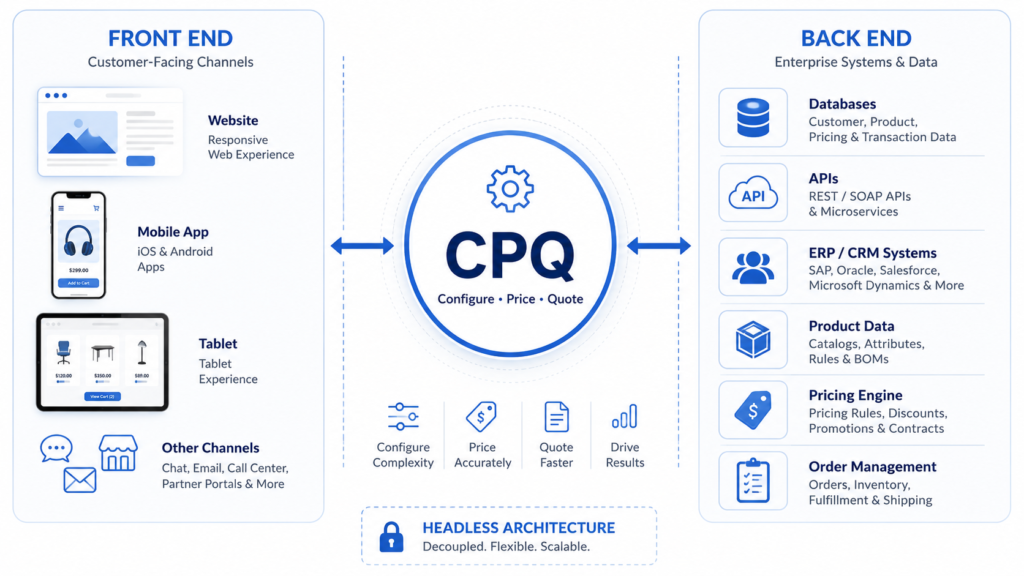
A typical headless CPQ workflow has four layers: the front end, an API layer, the CPQ engine, and connected systems such as CRM, ERP, and commerce. The front end captures choices. The API passes structured requests. The engine applies rules, pricing, and approvals. Connected systems provide customer, order, financial, and product data.
API-first architecture explained
In an API-first model, the platform is designed to expose quote actions as services. Some tools can return real-time pricing and product configuration data without first creating a formal quote record, while others expose cart and quote APIs that hide the internal complexity of CPQ processing from client developers.
This matters because it prevents rule duplication. Teams do not need to rebuild logic in every application; they call the same back-end service instead.
Integration with CRM, ERP, and ecommerce
Integration is where much of the business value shows up. CRM adds account and opportunity context. ERP contributes financial and fulfillment data. Commerce provides the buying surface. Product systems supply the catalog. When those inputs are connected, headless CPQ can keep quotes accurate across sales-assisted and self-service motions.
Role of microservices and cloud
Modern headless delivery is often paired with microservices and cloud-native services. Microservices let capabilities be managed independently. Cloud deployment adds elastic scaling, availability, and automated updates. Together, they help organizations support peak traffic, multiple channels, and frequent change. The role of microservices is especially important when pricing, catalog, and workflow logic need to evolve at different speeds.
Key Capabilities of Headless CPQ Platforms
What are the main benefits you can get after adopting a headless CPQ platform?
Dynamic pricing and configuration
A modern platform can enforce compatibility rules during configuration and apply volume discounts, regional pricing, channel pricing, promotions, and subscription logic in the same flow. That gives teams centralized control while still allowing flexible selling experiences.
Real-time quoting via APIs
Real-time quoting lets external applications receive priced configurations or formal quote outputs instantly. This shortens cycle time and makes self-service much more realistic for complex products and services.
Custom UI and front-end freedom
Because the quoting engine is decoupled, teams can build different experiences for buyers, partners, and internal sales. SDKs, web components, JavaScript modules, iframe embeds, and pure API delivery all support this front-end freedom.
Scalability and performance
Headless systems are also designed for scalability. Cloud APIs, intelligent caching, and faster cart operations help support heavy traffic, large catalogs, and responsive experiences across channels.
Benefits of Headless CPQ
The most important headless CPQ benefits go beyond simple flexibility.
Benefits for businesses
Businesses gain reuse, control, and faster change. Centralized rules reduce rework, improve integration, and make it easier to launch new products, channels, and experiences without multiplying back-end logic. Research on composable architectures also connects this model with gains in customer experience, automation, and adaptability.
Benefits for sales teams
Sales teams spend less time on manual pricing, quote rework, and approval chasing. Guided selling, real-time calculations, and automated document generation help them stay inside policy while moving faster. In practical terms, CPQ is designed to let sellers focus more on selling and less on assembling quotes by hand.
Benefits for customers
Customers get quicker, more transparent buying journeys. They can configure products, see pricing, and move between self-service and assisted sales without restarting the process. When the same back-end powers every touchpoint, the experience also feels more consistent and trustworthy.
Headless CPQ in Practice: Real-World Use Cases
Let’s have a look at the industries where headless CPQ is used most often:
Manufacturing and complex products
Manufacturing is a natural fit because products often have interdependent options, engineering constraints, and frequent catalog changes. CPQ rules validate what can actually be built and priced, which helps reduce downstream errors in procurement, production, and fulfillment.
B2B ecommerce and self-service portals
In B2B ecommerce, headless CPQ bridges the gap between complex selling and digital buying. It lets buyers research, configure, and request or generate quotes inside storefronts and portals instead of falling back to email and manual workflow. Vendor guidance for digital commerce and B2B CPQ increasingly frames this as a self-service requirement, not a nice-to-have.
Subscription and SaaS pricing models
Subscription businesses benefit because they must handle recurring charges, proration, bundles, renewals, and usage-based models. A headless approach lets these pricing services work inside product-led, portal, and rep-assisted flows from the same back end.
Headless CPQ vs Monolithic CPQ: Before and After
| Scenario | Before | After |
| New channel | Extra custom quoting logic or awkward embeds. | Same engine exposed through APIs. |
| UX redesign | Limited by the original suite UI. | Frontend can change independently. |
| Peak traffic | A tightly coupled application can become a bottleneck. | Caching and elastic scaling improve responsiveness. |
| Rules reuse | Harder to keep the catalog and pricing consistent across motions. | One back-end service governs all channels. |
| Architecture change | Replacing one part of the stack is difficult. | Modular services are easier to swap or extend. |
Challenges and Considerations
What should you consider before adopting a headless CPQ platform?
Implementation complexity
Headless CPQ is powerful, but it is not automatically simple. Product modeling, API design, testing, and workflow mapping still require discipline, and research on composable adoption shows that leadership support and organizational readiness remain common barriers.
Integration effort
Integration effort is the next challenge. Teams need clear ownership for product data, pricing, approvals, quote status, and synchronization between CRM, ERP, and commerce systems. Public vendor guidance also makes clear that complexity rises with the number of systems, price lists, rules, and supporting assets involved.
Governance and data consistency
Governance matters because every channel must use the same approved rules, product definitions, and discount logic. If the catalog or pricing model is poorly governed, consistency breaks quickly. Digital-commerce documentation also shows how much performance and eligibility behavior can depend on properly managed context rules, caching, and product metadata.
The Role of MACH Architecture in Headless CPQ
MACH is a useful framework for understanding headless CPQ. It combines microservices, API-first design, cloud-native SaaS, and headless delivery. That maps closely to what advanced CPQ programs need: independently managed services, reusable APIs, elastic infrastructure, and flexible experiences.
In this model, CPQ becomes a packaged business capability that works alongside commerce, search, identity, content, and billing rather than sitting as a closed bolt-on. Wider MACH research suggests that enterprises are increasingly comfortable with exactly this kind of modular assembly.
Future Trends in Headless CPQ
The next phase of headless CPQ is likely to be even more programmatic. Enterprise platforms are exposing more business capabilities as APIs and tools that can be used by apps, humans, and AI agents across many surfaces. That points toward broader use of quoting logic outside the browser-based application model.
At the same time, CPQ roadmaps increasingly point toward conversational configuration, automated quote assembly, smarter pricing recommendations, and deeper workflow orchestration. AI may accelerate those trends, but clean back-end logic and data governance will still be the foundation.
Why Headless CPQ Matters for Modern Enterprises
Modern enterprises need to support more channels while keeping control over pricing, approvals, and customer experience. Headless CPQ helps because it turns quoting into a reusable business service that can support both sales and commerce without duplicating logic.
The more a company depends on consistency across platforms, the more valuable that model becomes. In that sense, headless CPQ is not just a technical preference; it is a way to make complex selling more resilient as channels and buyer expectations keep changing.
Why CanvasLogic for CPQ Solutions?
The platform stands out for businesses that sell configurable products and want more than static quoting. Its CPQ positioning combines a rules-driven configurator, dynamic pricing, automated quote generation, and visual 3D or AR experiences, which help customers understand complex products before they buy.
It also emphasizes omnichannel deployment and integration. Its CPQ supports iframe, API, and JavaScript SDK embed options, along with CRM, ERP, PIM, PLM, and commerce connections. That makes it attractive for companies that want guided selling and quoting across ecommerce and sales-assisted channels.
In Closing
Headless CPQ is not just CPQ with an API. It is an architectural shift that separates the front end from the back end, centralizes rules, and makes quoting available wherever buyers and sellers work.
For companies with complex catalogs, multiple channels, and growing self-service expectations, that shift can improve speed, accuracy, and scalability without sacrificing governance.
FAQ
How long does a headless CPQ implementation usually take?
Implementation time varies widely. A focused rollout with a limited catalog and clear ownership can go live in weeks; one public case study documents a two-week implementation. Broader programs can take much longer when they include more systems, more rules, more assets, and deeper process redesign.
Can headless CPQ be used for small and mid-sized businesses?
Yes. The real question is not size but complexity. Official CPQ documentation clearly states that modern CPQ is for enterprise and midsize organizations, and the business case is stronger when a company has configurable products, complex pricing, multiple channels, or recurring quote errors. The “small business” part is therefore more of an implementation-fit question than an architecture limit.
What industries benefit the most from implementing headless CPQ?
The strongest fit is usually in sectors with complex products, variable pricing, or repeatable self-service demand, especially manufacturing, electronics, industrial equipment, B2B ecommerce, and subscription or SaaS businesses. Those are the environments where configuration rules, dynamic pricing, and fast quoting matter most.