
Key Facts:
- AI CPQ has evolved from a quoting tool into intelligent revenue infrastructure that connects configuration, pricing, approvals, contracts, billing, and renewals.
- The most valuable AI capabilities include predictive configuration, dynamic pricing, generative quote creation, conversational assistance, and automated approvals.
- AI-powered CPQ can shorten quote-to-cash cycles, improve quote accuracy, protect margins, enhance the buyer experience, and reduce sales onboarding time.
- No single platform is best for every company; the right choice depends on the organization’s industry, revenue model, product complexity, sales channels, and operational requirements.
- Conga is particularly strong for enterprise manufacturing, Subskribe for SaaS, DealHub for mid-market businesses, Nue for complex pricing, Mobileforce for field sales, and CanvasLogic for visual product configuration.
- Companies should evaluate CPQ platforms based on measurable revenue goals, product complexity, pricing requirements, integration needs, and the practical maturity of their AI features.
CPQ used to feel like a back-office calculator with a logo on it. Today, the category is far more interesting because it sits at the moment where commercial intent becomes operational reality: the product catalog is selected, pricing logic is enforced, discounts are governed, a quote and proposal are created, and downstream contracts, billing, and revenue recognition often start from the same data model.
That shift explains why evaluating AI CPQ software is really a revenue-design decision, not just a sales-tech purchase. The strongest tools now support recurring, usage-based, and hybrid subscription models; they also reduce handoffs between sales, RevOps, finance, and legal, which makes quoting faster and forecasting cleaner.
It also explains why the market feels newly urgent. Salesforce’s legacy Salesforce CPQ is now end of sale for new customers, and the company’s investment has shifted toward Revenue Cloud Advanced within Agentforce Revenue Management. In parallel, Deloitte reports that digitally mature B2B suppliers outperform lower-maturity peers on annual sales goals, and Salesforce says reps still lose most of their week to non-selling work.
Why Best AI CPQ Software Became a Strategic Priority in 2026
AI CPQ became strategic in 2026 because the old problem was never just manual quoting. The real problem was that pricing, approval, buyer communication, order capture, and revenue operations were spread across too many systems for too long.
What Is AI-Powered CPQ
AI-powered CPQ software uses AI to assist or automate configuration, pricing, quoting, approvals, and related revenue decisions inside a governed commercial workflow. Salesforce frames CPQ as part of a unified quote-to-cash lifecycle; Oracle has added generative and agentic features directly inside CPQ, and Nue describes its approach as an agentic revenue architecture where AI builds pricing and runs quotes with finance guardrails.
Predictive product configuration
Predictive product configuration matters because sellers increasingly need help navigating compatibility, bundles, and complex solution design without escalating every deal to engineering. Oracle’s guided Configuration AI-Assist Agent captures natural-language requirements and proposes best-fit selections, while CanvasLogic uses guided selling and rules to narrow options for complex products.
Dynamic pricing recommendations
Dynamic pricing recommendations matter because modern B2B deals rarely fit a static price list. Conga synchronizes AI-driven pricing recommendations into the quoting workflow; Mobileforce says its AI pricing engine analyzes market conditions and customer history; and Oracle’s Deal Pricing AI-Assist can translate a target total discount or contract value into line-level pricing actions.
Generative quote creation
Generative quote creation turns a traditionally tedious task into a guided commercial draft. Salesforce says Agentforce can instantly generate personalized customer quotes and summarize them, while Oracle CPQ supports generative quote summaries for internal and customer-facing communication. PandaDoc plays at the same layer through automated quote assembly tied to templates, product data, and signature workflow.
Conversational sales assistance
Conversational sales assistance is becoming the most visible face of AI-powered CPQ software because it lets non-experts ask for a quote the way they would ask a colleague for help. Oracle’s Quote Assistance Agent answers questions in natural language and can now handle more verbose prompts, while Nue lets teams describe a ramp, discount, or usage tier in plain language and compile it into executable pricing logic.
Automated approval intelligence
Automated approval intelligence matters because margin is usually lost in exceptions, not in standard deals. Salesforce embeds discounting rules and automated approvals into quoting, DealHub emphasizes automated and parallel approval workflow support, and Subskribe lets teams design approval flows based on deal size, payment terms, and discount conditions.
What Are the Core Benefits of the Best AI CPQ Software?
The best AI-powered CPQ solutions do not merely speed up quotes. The benefits are the following: faster quote-to-cash cycles, higher quote accuracy, improved margin protection, better buyer experience, and reduced sales onboarding time.
Faster quote-to-cash cycles
Faster quote-to-cash cycles are the first visible win because AI and automation remove repetitive work from the quoting path. Salesforce positions Revenue Cloud as a complete quote-to-cash platform, DealHub highlights faster time-to-value and quote creation in minutes, and PandaDoc focuses on seamless quoting, approval, and signature from inside the CRM.
Higher quote accuracy
Higher quote accuracy comes from governed logic, not just nicer UI. Salesforce, Oracle, DealHub, and CanvasLogic all center their value story on valid configuration, automated pricing rules, and reduced misquotes, while Conga explicitly frames its CPQ around accurate, margin-protected quotes for complex product mixes.
Improved margin protection
Improved margin protection is where AI CPQ earns executive attention. Conga talks about profit-first precision, DealHub about built-in guardrails and smart discounting, and Mobileforce about margin protection controls inside its pricing engine. That combination turns pricing from a spreadsheet habit into a policy-enforced system.
Better buyer experience
Better buyer experience sounds soft, but it is increasingly hard revenue infrastructure. Deloitte notes that B2B buyers now expect digitized experiences, PandaDoc stresses impressive, automated quotes, and CanvasLogic differentiates by making product buying visual and interactive rather than abstract and error-prone.
Reduced sales onboarding time
Reduced sales onboarding time is one of the least glamorous but most durable benefits. If pricing knowledge lives in the system instead of in one heroic sales engineer, ramp time falls. Nue markets plain-language summaries that let admins understand rules without deep CPQ expertise, DealHub emphasizes intuitive workflows for seller adoption, and Subskribe says teams can start using its CPQ with virtually no user training.
What Are the Top AI CPQ Software Platforms in 2026?
The best AI CPQ platforms in 2026 are the following: Salesforce Revenue Cloud and Agentforce, DealHub CPQ, Oracle CPQ, Conga CPQ, PandaDoc CPQ, Mobileforce CPQ, CanvasLogic, Nue, and Subskribe.
Salesforce Revenue Cloud and Agentforce
Salesforce is the safest shortlist choice for companies already standardized on Salesforce CRM and looking for a broad quote-to-cash platform. Revenue Cloud Growth starts at $150 per user per month and Advanced at $200 per user per month billed annually, while Agentforce pricing is layered separately through add-ons, licenses, flex credits, or conversation pricing. The strongest pros are native ecosystem fit, structured configuration, broad revenue-lifecycle scope, and visible AI roadmap; the trade-offs are cost, architectural breadth, and the reality that legacy Salesforce CPQ is now end of sale for new customers.
DealHub CPQ
DealHub is one of the most convincing mid-market options because it combines CPQ, buyer collaboration, subscription logic, and revenue operations framing without looking like a heavyweight enterprise suite. Its pros are guided quote configuration, adaptive pricebooks, automated approvals, partner quoting, strong CRM integrations, and a no-code deployment message; the main cons are less transparent pricing and a lighter public AI story than the most AI-native entrants. Pricing is custom.
Oracle CPQ
Oracle remains a serious choice for companies that need deep control and enterprise process rigor. Oracle CPQ covers opportunity-to-quote-to-order processes, and recent releases added generative quote summaries, quote assistance, guided configuration AI, deal-pricing AI, and AI-generated rule descriptions. Its pros are depth, rapid AI feature expansion, and strong fit for complex environments; its cons are a steeper implementation profile and less consumer-friendly pricing transparency, although Oracle’s U.S. public-sector price list shows $240 per hosted named user for Fusion CPQ.
Conga CPQ
Conga earns its place because it is unusually strong where product complexity and commercial scale collide. The company positions Smart CPQ for manufacturers and distributors, supports 100,000-plus line items, integrates pricing, quoting, and contracts, and layers AI-driven pricing insight on top. The pros are CRM-agnostic flexibility, manufacturing strength, and margin governance; the cons are custom pricing and a platform breadth that may feel heavier than necessary for simpler teams.
PandaDoc CPQ
PandaDoc is the most approachable option in this list for organizations that care as much about getting polished quotes signed as they do about deep enterprise pricing logic. The pros are fast adoption, strong document and e-signature capabilities, approval workflow, deal rooms, and public entry pricing; the cons are that it is not positioned as the deepest industrial or multi-entity revenue engine. Public pricing shows CPQ document fees starting around $2 to $3.50 per document depending on plan structure, while Enterprise seat pricing is custom.
Mobileforce CPQ
Mobileforce deserves more attention than it usually gets because it is one of the clearest answers for field-heavy selling. The platform markets AI-driven pricing, customer-tier discounting, competitive price analysis, and offline quote-plus-CRM operation. The pros are mobile-first design, field execution, public entry pricing, and fast access for distributed sales motions; the cons are a smaller ecosystem than the category giants and less evidence of broad enterprise standardization. Public pricing lists an Enterprise plan at $65 per user per month paid annually.
CanvasLogic
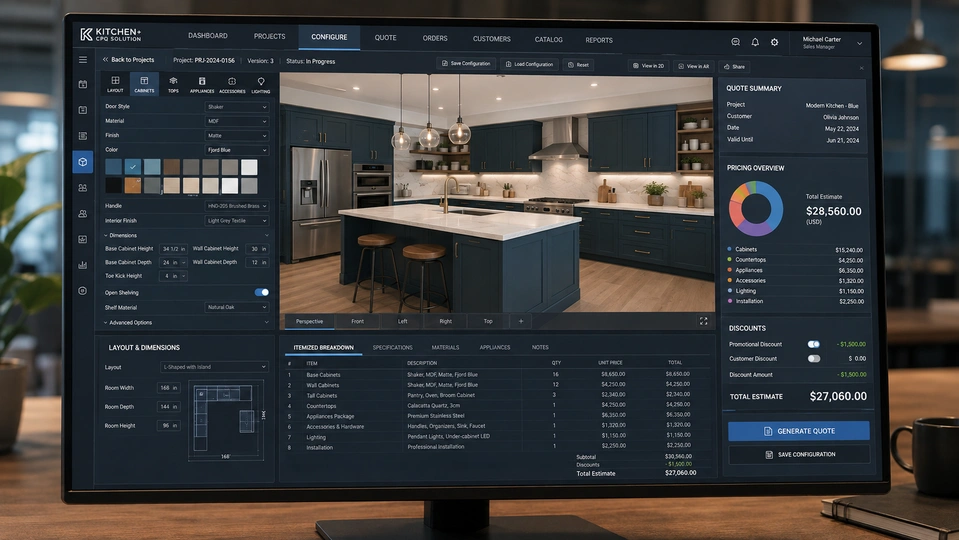
CanvasLogic is different in a useful way. It mixes CPQ with 3D and AR visualization, which makes it compelling when seeing the configured product is part of the purchasing decision, not a cosmetic extra. Its pros are visual selling, guided questionnaires, dynamic pricing, automated proposal output, and strong manufacturing and custom-product storytelling; the cons are demo-only pricing and a narrower fit for businesses that do not need visual commerce.
Nue
Nue is one of the most interesting newer-generation platforms because it treats pricing logic itself as an AI surface. It lets teams describe rules in plain language, builds and audits that logic, and runs quotes from one data model across CPQ, billing, and lifecycle management. The pros are hybrid pricing support, AI-native rule management, and finance guardrails; the cons are custom pricing and a more focused market footprint than Salesforce or Oracle.
Subskribe
Subskribe is one of the strongest purpose-built platforms for recurring-revenue companies. It supports recurring, one-time, usage-based, and ramp pricing; it also connects quoting to billing and revenue recognition in the same quote-to-revenue model. The pros are speed, SaaS-native packaging, strong approvals, and finance alignment; the cons are a primary focus on modern SaaS rather than every industry under the sun, plus custom pricing rather than a simple public rate card.
| AI CPQ feature | What it does | Primary business impact | Platforms with relevant capabilities |
| Natural language quote generation | Converts plain-language deal requirements into structured quotes, summaries, or pricing rules | Reduces administrative work and makes CPQ easier for sellers to adopt | Salesforce, Oracle, Nue |
| Revenue forecasting intelligence | Uses structured quote, pipeline, and financial data to improve revenue visibility | Produces cleaner forecasts and more reliable sales planning | Salesforce, DealHub |
| Real-time discount guidance | Recommends or controls discounts based on deal context, customer history, and pricing rules | Protects margins while allowing sales teams to respond quickly | Conga, Oracle, DealHub, Mobileforce |
| Cross-sell and upsell recommendations | Suggests compatible products, bundles, upgrades, or expansion opportunities during configuration | Increases average deal value and supports more |
Comparative Analysis of Leading AI CPQ Vendors
The smartest way to compare vendors is not by counting features. It is by matching commercial complexity to operational style. A company selling configurable medical equipment through dealers needs something very different from a SaaS firm selling usage credits, and both need something different from a field-service business quoting onsite.
| Buying situation | Best current fit | Why |
| Enterprise manufacturing | Conga Smart CPQ | Conga explicitly positions Smart CPQ for manufacturers and distributors, supports engineering logic, AI-driven pricing guidance, and 100,000-plus line items. |
| SaaS companies | Subskribe | Subskribe is purpose-built for subscription-first SaaS, supports ramps, amendments, usage billing, and unified quote-to-revenue reporting. |
| Mid-market businesses | DealHub CPQ | DealHub combines guided quoting, seller adoption, CRM flexibility, buyer collaboration, and no-code deployment. |
| Complex pricing models | Nue | Nue’s strongest differentiator is AI-built pricing logic in plain language across discounts, ramps, term pricing, and usage tiers. |
| Mobile sales teams | Mobileforce CPQ | Mobileforce explicitly supports offline quote generation and CRM updates for field teams, with mobile-first positioning. |
Best platform for enterprise manufacturing
For enterprise manufacturing, the best platform is the one that can govern engineering constraints and commercial complexity at once. Conga and CanvasLogic are especially strong here, but Conga has the clearer enterprise-scale story for massive line-item quoting, complex industrial logic, and controlled margin governance.
Best option for SaaS companies
For SaaS, the center of gravity has moved from quote generation to monetization design. Subskribe and Nue both understand ramps, usage, amendments, and hybrid packaging far better than legacy manufacturing-style CPQ models, with Subskribe having the more complete public quote-to-revenue story today.
Best choice for mid-market businesses
For mid-market companies, elegance beats theoretical feature depth. DealHub is hard to ignore because it balances guided quoting, approvals, channel selling, and buyer-facing collaboration without demanding a full enterprise transformation on day one.
Best solution for complex pricing models
For pure pricing complexity, Nue is the most forward-looking option in this list because it treats pricing design as a conversational and governable AI problem. Oracle is still the stronger traditional enterprise answer, but Nue is the more interesting architecture when pricing changes constantly. That is an inference based on each vendor’s official positioning and AI feature set.
Best platform for mobile sales teams
For mobile and field sales, Mobileforce has the clearest product-market fit. Its offline support is not a side note; it is central to the platform story, which matters if reps quote at customer sites, events, or locations where connectivity is unreliable.
Which AI Features Matter Most in Modern CPQ Platforms?
Not every AI feature is equally useful. The features that matter the most are natural language quote generation, revenue forecasting intelligence, real-time discount guidance, cross-sell and upsell recommendations, and contract risk detection.
Natural language quote generation
Natural language quote generation matters because it compresses expertise into the interface. Salesforce uses Agentforce for quote creation and summarization, Oracle supports natural-language quote assistance and guided configuration, and Nue lets teams encode pricing in plain language. If a seller can describe the deal naturally and the system turns that into a compliant quote, adoption tends to rise.
Revenue forecasting intelligence
Revenue forecasting intelligence matters because CPQ is where commercial intent first becomes structured data. Salesforce explains that revenue forecasting combines pipeline and financial inputs to predict performance, while DealHub highlights revenue intelligence and structured data capture around quotes. Put simply, clean quote data improves pipeline visibility and makes forecasting less political and more evidence-based.
Real-time discount guidance
Real-time discount guidance is one of the highest-value AI features because it protects gross margin without freezing the sale. Conga provides pricing guidance and guardrails, DealHub pushes structured approvals and approval-aware pricing, Mobileforce uses customer and market context in its pricing engine, and Oracle’s deal-pricing agent can work backward from a target deal outcome.
Cross-sell and upsell recommendations
Cross-sell and upsell recommendations matter when CPQ becomes a guided selling engine instead of a calculator. Conga says its AI agents can surface cross-sell opportunities during configuration, DealHub ties CPQ to renewals and expansion control, and Subskribe is built around upsell, cross-sell, amend, and renew motions. Good AI here should feel like relevant bundling, not random add-on spam.
Contract risk detection
Contract risk detection matters because the commercial deal is not done when the number is approved; it is done when the agreement is executable and safe. Conga’s contract intelligence positioning focuses on AI-driven risk control, and DealHub’s contract AI materials emphasize flagging risky terms or missing clauses. That means modern CPQ increasingly works best when it is close to CLM rather than isolated from it.
What Are the Industry-Specific Use Cases for AI CPQ?
AI CPQ is most persuasive in the following industries: manufacturing and industrial equipment, medical devices and healthcare, telecommunications, software and SaaS, and automotive and mobility.
Manufacturing and industrial equipment
Manufacturing teams need valid configurations, engineering logic, and often dealer-friendly selling paths. Conga and CanvasLogic both target this space directly, with Conga emphasizing scale and pricing precision while CanvasLogic adds visualization for complex custom products.
Medical devices and healthcare
Medical-device sales are high stakes because technical accuracy and customer clarity both matter. CanvasLogic explicitly positions CPQ for medical device manufacturing, and Conga’s healthcare messaging emphasizes competitive quoting with compliance-conscious workflow support.
Telecommunications
Telecommunications needs attribute-based pricing, complex contracts, eligibility rules, and omnichannel quoting. Salesforce’s Communications Cloud materials make that case directly, including support for context-sensitive pricing and industry CPQ.
Software and SaaS
Software and SaaS vendors need hybrid charging, credits, co-terming, upgrades, renewals, and usage-aware pricing. That is why Nue and Subskribe feel more natural in this segment than older hardware-first CPQ designs.
Automotive and mobility
Automotive selling is configuration-heavy and rule-bound, especially once model variants, regional packages, and special-purpose vehicles enter the picture. CanvasLogic’s automotive CPQ content centers exactly on that problem.
How to Choose the Best AI CPQ Software
Choosing CPQ well is mostly about refusing to buy on demo energy alone. The right platform should match your revenue model, your pricing volatility, your approval culture, and your downstream finance requirements.
Define revenue operations goals
Define your revenue operations goals first because “better quotes” is too vague to buy software against. Decide whether your real target is faster quoting, tighter margin control, better quote-to-order conversion, cleaner renewal motions, less reconciliation, or stronger revenue predictability. Conga’s KPI guidance points to quote accuracy, response time, price realization, adoption rates, revenue from existing customers, and time to market for price changes as useful post-implementation measures.
Map product complexity
Map product complexity honestly. If you sell industrial systems with engineering dependencies, you need something very different from a company selling a simple SaaS seat bundle. If you need visual configuration, consider CanvasLogic. If you need hybrid recurring and usage pricing, look harder at Nue or Subskribe. If you need a broad enterprise quote-to-cash stack on Salesforce, Revenue Cloud is the obvious benchmark.
Evaluate AI maturity
Evaluate AI maturity with a little skepticism. A chatbot on top of static rules is not the same as AI that understands configuration, pricing, and approvals in context. Oracle’s recent release cadence shows deep embedded AI, Nue uses AI to build and audit pricing logic, and Salesforce is integrating agents directly into revenue workflows. The right question is not “Does it have AI?” but “Where does AI change operational outcomes without breaking governance?”
Conclusion
The best AI CPQ software in 2026 is the platform that makes your revenue model easier to govern, not the one that produces the flashiest demo. For Salesforce-centric enterprises, Revenue Cloud and Agentforce are the reference point; for industrial and manufacturing complexity, Conga is especially strong; for mid-market buying teams, DealHub is practical and convincing; for SaaS monetization, Subskribe and Nue feel closest to where the market is going; for field teams, Mobileforce is unusually differentiated; and for visual product selling, CanvasLogic has a real niche.
The category is moving from quoting software to intelligent revenue infrastructure. That is why the best winners are no longer the tools that only calculate a price; they are the ones that connect commerce, approvals, contracts, billing, renewals, and analytics into one trusted operating layer.
FAQ
Can AI CPQ platforms support channel partner ecosystems?
Yes. DealHub explicitly supports partner and channel quoting, Salesforce positions its CPQ across channels, and Subskribe includes reseller capability for revenue growth. In practice, partner support is most valuable when the same product rules, pricing guardrails, and approval policies apply to both direct and indirect sales.
How do AI CPQ systems improve sales forecasting accuracy?
They improve forecasting by capturing structured deal data earlier and more consistently. Salesforce notes that revenue forecasting depends on clean pipeline and financial signals, while DealHub and similar revenue-intelligence platforms use quote-level data to feed better visibility into bookings, conversion, and expansion patterns.
What KPIs should companies track after AI CPQ implementation?
Track quote accuracy, quote response time, price realization, CPQ adoption rate, revenue from existing customers, and time to market for pricing changes. Depending on your model, you may also want approval SLA, renewal conversion, amendment cycle time, and forecast variance between quoted value and recognized revenue.