
Key Insights
- CRM is a system for managing a company’s interactions with current and potential customers. It puts customer information into one place so teams can act on it.
- CPQ software automates product configuration, pricing, and quote generation. It helps increase sales efficiency and reduce errors.
- CRM is typically the system of record for accounts, contacts, and opportunities, including the sales pipeline and many activities that precede quoting.
- CPQ sits inside the quote stage of quote to cash, where offers are configured and translated into accurate quotations and proposals.
- Integrating CRM with CPQ improves proposal speed and accuracy, reduces errors, and can be done via APIs or integrated product architectures.
- In practice, CRM and CPQ work best together. CRM manages demand and deal progression. CPQ manages configuration, pricing, and quoting quality at the moment of purchase intent.
Most sales teams do not struggle because they lack leads. They struggle because revenue processes break down under complexity. Products have many options, pricing has many rules, and customers expect fast responses across digital channels. CPQ software makes quoting reliable and fast. It standardizes configuration and pricing logic. At the same time, CRM platforms unify customer data, activities, and sales execution across the pipeline.
When leaders ask about CPQ vs. CRM, it often reflects a deeper problem. Teams are trying to use one system to do two different jobs. CPQ and CRM are complementary, but they work with different parts of the revenue engine optimization. CPQ vs. CRM is not a winner-takes-all decision. That’s because the systems are designed around different data ownership, different workflow responsibilities, and different stakeholders. In well-run revenue operations, CPQ and CRM integration is what turns customer intent into fast, compliant, profitable offers.
What Is CRM
Customer relationship management, or CRM, is commonly defined as a system for managing interactions with current and potential customers to improve relationships and grow the business.
What Is CPQ Software
CPQ stands for Configure, Price, Quote. At its simplest, CPQ software enables businesses to configure complex products and services, apply accurate pricing, and generate professional quotations quickly and consistently.
CPQ is built to address a specific operational risk. Whenever a product or service can be sold in many combinations, manual quoting becomes slow and error-prone. CPQ improves the sales process. How? It automates product configuration, pricing, and quote generation to increase efficiency and reduce errors. And it supports producing accurate, personalized quotes faster.
CPQ vs. CRM: Key Differences
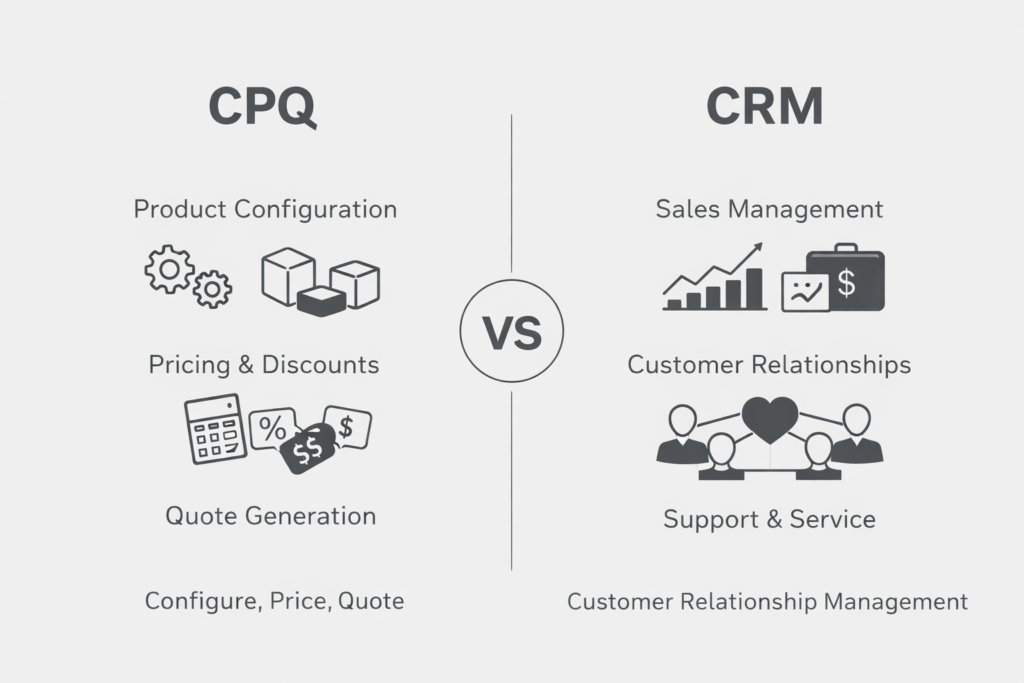
The simplest distinction is that CRM manages customer relationships and deal progression, while CPQ manages offer correctness, including configuration validity and pricing governance, at the moment a quote is produced.
| Dimension | CRM | CPQ |
| Primary purpose | Manage customer data and interactions, support sales execution, and relationship growth | Automate configuration, pricing, and quoting to produce fast, accurate offers |
| Core objects | Accounts, contacts, leads, opportunities, activities | Product configuration rules, product catalog, pricing rules, quote, and line items |
| Primary outcome | Pipeline visibility and predictable execution | Error-resistant quotes that protect margin and reduce cycle time |
| Typical place in the process | Broad lifecycle around selling, from lead to opportunity management | Quoting stage inside quote to cash, when offers are assembled and priced |
| Stakeholders | Sales, marketing, service, leadership | Sales, sales operations, finance, product, and legal for approvals |
| Key strength | Centralized customer context and analytics for planning | Standardized quoting with pricing and discount control |
This comparison reflects how CRM centralizes customer information for teams, while CPQ explicitly automates configuration, pricing, and quote generation and is treated as a concrete step in quote-to-cash.
Purpose and business focus
- CRM is relationship-first: it helps teams manage interactions and customer information to improve relationships and profitability.
- CPQ is transaction-precision-first: it is designed to ensure that what gets sold can actually be delivered and billed correctly by automating configuration and pricing decisions so the quote can be produced quickly and consistently.
Data management and ownership
- CRM is typically the owner of customer and opportunity data that describes who the buyer is and where a deal sits in the pipeline.
- CPQ typically owns the data that describes what is being sold and the rules that govern how it must be configured, priced, and approved, often anchored in a product catalog and pricing policies.
Sales workflow responsibilities
- CRM supports the operating rhythm of selling: activity tracking, opportunity progression, and forecasting discipline that helps leadership plan without end-of-period surprises.
- CPQ supports the moment where an opportunity turns into an offer: configuration validation, pricing calculation, discount approvals, and quote creation that customers can accept. This is why CPQ is often described as part of quote to cash rather than a replacement for CRM.
User roles and stakeholders
- CRM is broadly used by sales teams and leadership, and it often serves multiple departments that need customer context and analytics.
- CPQ is used heavily by sales, but it also has strong cross-functional dependencies, because pricing governance, discount approvals, and proposal consistency often involve finance and operations.
How CPQ Complements CRM
CPQ is most valuable when it plugs into CRM at the moment a qualified deal demands a reliable, fast offer. Instead of forcing sellers to leave the CRM to build quotes in spreadsheets, CPQ can embed structured quoting inside the CRM workflow, so the quote becomes part of the opportunity record and the pipeline remains auditable.
Quote generation and configuration
CPQ complements CRM by turning customer requirements captured in CRM into a valid product configuration. It then generates a quote based on those decisions. In practice, this reduces back-and-forth. Because the configuration step acts as a rules check before anything is promised to the customer.
Pricing automation and discount control
Pricing is where margin leakage often happens. Especially when discounting is inconsistent across reps or regions. CPQ platforms commonly provide consistent pricing and discounting control. It includes approval workflows, which shift discounting from ad hoc behavior to governed policy.
Proposal and document generation
Many CPQ deployments extend beyond a numeric quote into proposals and documentation that are consistent and professional. This aligns with how quote-to-cash includes drafting proposals and moving toward payment. And it improves the customer experience because customers receive clearer, faster documentation.
Benefits of CRM and CPQ Integration
CRM and CPQ integration is not just a technical project. It is an operating model decision: you are defining a single, connected path from customer context to commercial offer and from offer back into pipeline analytics and forecasting.
Improved data accuracy
When CPQ pulls data from CRM and other systems, proposals can be produced more accurately in less time because customer context and opportunity details do not need to be re-entered manually.
Faster sales cycles
CPQ is designed to accelerate the sales cycle by automating configuration, pricing, and quote generation, and integration allows that speed gain to occur without breaking CRM pipeline discipline.
Better customer experience
Integrated CPQ and CRM reduce proposal errors and streamline operations, which improves the buyer experience because customers receive consistent, accurate responses without delays caused by internal rework.
Enhanced revenue predictability
Forecasting quality depends on having accurate opportunity and quote data. CRM forecasting uses pipeline activity to generate near real-time views of expected revenue, and integration ensures that quoting outcomes map back into that model rather than living in disconnected documents.
Reduced manual errors
Manual quoting produces errors because humans must apply complex rules repeatedly under time pressure. CPQ reduces errors by standardizing configuration and pricing logic, and integration reduces errors further by removing duplicate data entry between systems.
CPQ and CRM in 3D Product Configuration
For configurable products, buyer confidence often depends on visibility. A quote can be technically correct and still fail to convert if the customer cannot confidently imagine what they are buying. This is where visual, 3D configuration becomes a strategic extension of CPQ inside the CRM-led sales process.
Visual configuration in sales processes
In practice, visual configuration supports sales teams by reducing ambiguity. Instead of describing a configuration in words and part numbers, sellers can use a visual model that updates as configuration decisions are made, which can reduce friction in approvals and speed up quoting.
Integration with ecommerce and digital channels
As digital selling expands, the ability to use the same configuration and pricing logic across channels becomes critical. Headless and composable commerce approaches emphasize decoupling experience layers from backend processes so that web, mobile, partner portals, and assisted sales can share the same backend logic while presenting different user experiences.
Impact on buyer decision-making
From a commercial perspective, the mechanism is straightforward: better visualization reduces uncertainty, which supports conversion, especially when combined with accurate real-time pricing that keeps the buyer oriented around trade-offs they can understand.
Choosing the Right CPQ for your CRM
Selecting CPQ is not only about features. It is about fitting with your CRM data model, the complexity of your product catalog, and the scalability of your integration approach as your business grows and channels multiply.
Integration capabilities
A CPQ must integrate cleanly with CRM so that customer data, quotes, and opportunities stay synchronized. Integration can be achieved via APIs or integrated architectures, and strong integration reduces operational friction and improves scalability.
Scalability and performance
Scalability is not just about handling more users. It is about handling more configurations, more pricing rules, and more channels without slowing down the quoting workflow. Visual configurators also add performance requirements because rendering and real-time rules must remain responsive.
Customization and flexibility
CPQ must map to your real selling reality. If your configuration logic, pricing tiers, and approval workflow cannot be represented accurately, teams will revert to manual workarounds that break governance. This is why many CPQ programs prioritize rule modeling, pricing guardrails, and alignment with sales operating processes before adding cosmetic customization.
Analytics and reporting features
CRM reporting often centers on pipeline analytics and forecasting, while CPQ reporting tends to focus on quote performance, discount patterns, and product mix. The most valuable scenario is when analytics connects the two: which configurations sell, at what discount levels, in which segments, and how those patterns influence forecast accuracy and revenue outcomes.
Common Implementation Challenges
Implementation issues usually come from misalignment between data, process, and adoption. CPQ is extremely sensitive to upstream data quality and to the completeness of configuration and pricing logic, so weak foundations show up immediately in quoting errors and low trust.
Data synchronization issues
Data synchronization often fails when product data, pricing rules, and customer context are inconsistent across systems. Many implementation guides and postmortems point to poor data quality and underestimated complexity as recurring causes of problems, especially when migrating from legacy quoting tools.
User adoption barriers
Even technically sound CPQ deployments can underperform if sales teams resist the new workflow. Adoption problems often occur when CPQ feels slower than old habits at first or when guided workflows do not match how sellers qualify and present solutions. Adoption improves when CPQ reduces effort, not when it adds steps.
Integration complexity
Integration complexity rises with the number of systems involved, such as ERP, billing, ecommerce, and document generation. While APIs make connectivity possible, teams still need careful mapping of which system owns which data, how updates flow, and how exceptions are handled.
Future Trends in CPQ and CRM
CRM and CPQ are converging toward a shared goal: more automation, more intelligence, and more flexible architectures that support personalization across channels without sacrificing governance.
- AI-driven sales automation
AI is increasingly embedded in CRM to help sellers summarize records, prepare for meetings, and execute daily tasks more efficiently. On the CPQ side, the likely path is AI-assisted configuration and quote creation. Here, automation helps recommend bundles, detect risky discounts, and speed up approvals while keeping pricing governance intact.
- Personalization and predictive selling
Personalization depends on trusted customer data and product logic. CRM centralizes customer information so teams have insights when needed. CPQ enforces configuration validity and pricing consistency. Together, they enable personalization that is operationally feasible. It means they tailor the offer but still govern it.
Predictive selling also depends on forecastable execution. CRM forecasting combines pipeline activity and categorization to give near real-time views of expected revenue. And this becomes more accurate when quote data and product mix are captured in structured CPQ objects rather than scattered documents.
- Headless and composable architectures
Composable and headless architectures are gaining attention because they decouple experience layers from backend engines. In ecommerce, headless commerce separates front-end experience from back-end processes. And composable approaches modularize more of the stack so teams can assemble best-fit components.
Why CanvasLogic for CPQ and CRM Integration?
CanvasLogic positions its CPQ around visual configuration, real-time pricing, and CRM connectivity, which aligns with where modern selling is heading: more guided selling, more self-service, and more consistency across digital channels and assisted sales.
For complex products, CanvasLogic also emphasizes 3D configuration and a dynamic pricing engine that updates in real time as customers configure products, aiming to reduce delays and improve customer satisfaction.
Conclusion
The highest-performing organizations do not treat this as CRM vs. CPQ. They connect the systems so that customer context flows into quoting. And quoting outcomes flow back into analytics, forecasting, and revenue management discipline. The result is less manual work, fewer errors, faster cycles, and better customer experiences across digital channels.
FAQ
How long does CPQ implementation typically take?
The time it takes to implement depends mostly on how complicated the product is. It also depends on how many integrations are needed.
What industries benefit most from CPQ tools?
CPQ is most valuable anywhere products or services are configurable, and pricing is rule-driven, especially where sales cycles require accurate proposals. Manufacturing is frequently cited because configured products have many options, compatibility constraints, and documentation requirements.
Will CPQ make the sales process too complex for non-technical users?
Guided selling methods are meant to help salespeople and customers set up complicated products even if they don’t know much about them. This is one reason why visual configurators and step-by-step configuration flows are so popular in modern CPQ design.
Is CPQ only useful for large enterprises with complex products?
CPQ is strongly associated with complex products and complex pricing. But the underlying value scales down. Any organization that needs consistent configuration, pricing governance, and faster quoting can benefit. Implementations can be phased to match maturity and size.