
Highlights:
- B2B buyers expect self-service configuration and real-time pricing, even for complex products.
- CPQ is the only scalable way to sell modular and contract-based products online without manual quoting.
- Modern CPQ turns engineering and pricing logic into usable digital buying experiences.
- Visual and AI-driven configurators reduce errors and increase buyer confidence.
- Real-time pricing engines protect margins and enforce commercial rules automatically.
- CPQ shortens sales cycles by automating configuration, pricing, and quoting.
- Integration with CRM, ERP, and ecommerce systems determines long-term success more than features.
B2B buying has changed, and it changed faster than most organizations expected. Buyers now behave like consumers. They want clarity, speed, transparency, and control. They want to explore options on their own terms, without waiting days for a quote or emailing spreadsheets back and forth.
At the same time, B2B products have not become simpler. They are more modular, more customizable, and more constrained by pricing rules, technical dependencies, and contract logic. This tension is exactly where CPQ software earns its place.
CPQ for B2B ecommerce bridges the gap between complex internal logic and a smooth external buying experience. It translates engineering rules, pricing policies, and sales constraints into something buyers can actually use.
What Is CPQ Software for B2B Ecommerce?
CPQ stands for Configure, Price, Quote. B2B CPQ makes complex products sellable online without chaos behind the scenes.
Instead of static product pages and manual quotes, CPQ turns configuration and pricing logic into a living, automated workflow that works across sales teams, distributors, and self-service buyers.
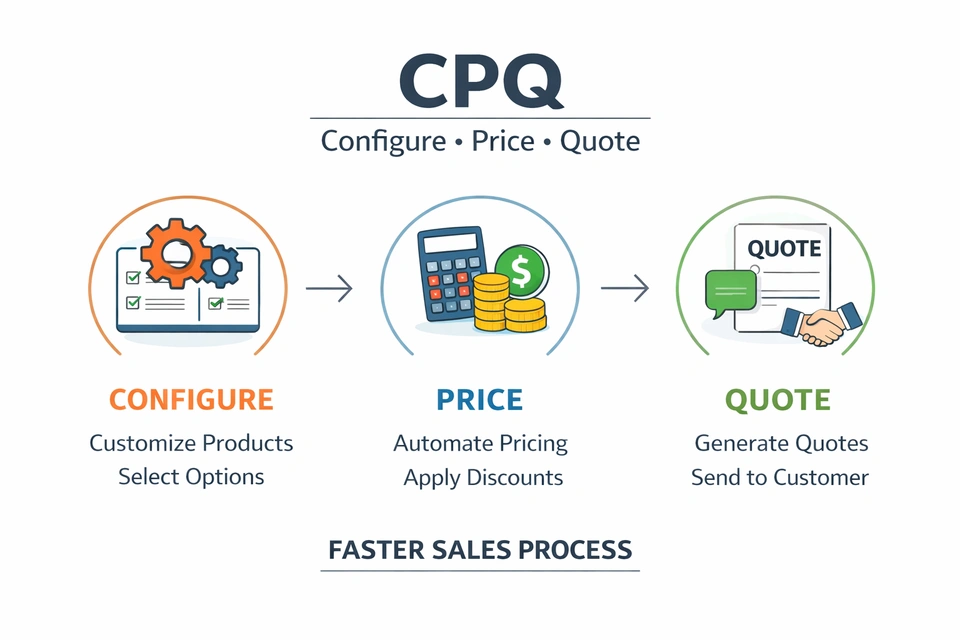
Defining Configure, Price, Quote
“Configure” means guiding users through valid product combinations. It prevents impossible builds and enforces technical and commercial rules automatically.
“Price” means calculating accurate prices in real time. That includes volume discounts, customer-specific agreements, regional pricing, promotions, and margins.
“Quote” means generating a formal, error-free proposal that can move directly into approval, contract, and order fulfillment.
From sales-rep tools to self-service platforms
Early CPQ systems were designed for internal sales teams. They lived inside CRM systems and required training and discipline to use correctly.
Modern Configure, Price, Quote has moved outward. Today, CPQ powers self-service portals, partner platforms, and B2B ecommerce storefronts. Buyers can configure products themselves while CPQ ensures accuracy and compliance behind the scenes. B2B commerce and CPQ work together to turn complex products into scalable, self-service buying experiences.
It refers to everything, even the most complex products. For example, configuring a robotic biolab. With the right tool, it’s easy to configure an accurate laboratory with the right equipment, tools, and instruments, add/delete objects, and customize according to your preferences and budget.
Why CPQ Is Non-Negotiable for Modern B2B Success
Configure, Price, Quote is no longer a nice-to-have tool. For many B2B organizations, it is the only way to scale digital sales without losing control.
Simplifying complex product configuration
Complex products kill conversion when buyers feel lost. Configure, Price, Quote transforms complexity into guided decisions, presenting only valid options at every step. For example, when configuring your perfect kitchen, a CPQ tool will help you choose only the kitchen tops that would fit in your room and the material that would fit into your budget. This way, there will be no guessing game whether the ready kitchen will meet your size and budget requirements.
Ensuring accurate, dynamic pricing
Manual pricing breaks under pressure. CPQ applies pricing logic consistently, even when rules are complex and customer-specific.
Accelerating quote generation and sales cycles
What once took days or weeks can happen in minutes. Faster quotes mean faster decisions and fewer stalled deals. When working on our Automata project, we helped the company integrate with HubSpot. This helped sales agents know what the prospect is trying to configure and what their interests are. And sales agents could reach out and start the conversation based on what they already know about the clients’ interests. This means deals were closed much faster. No more cold pitching and long sales cycles.
Eliminating errors and boosting trust
Nothing erodes trust faster than incorrect quotes. Configure, Price, Quote eliminates mismatches between sales promises and operational reality.
Enabling seamless self-service buying
Configure, Price, Quote empowers buyers to explore configurations independently. Sales teams can focus on high-value conversations instead.
5 Critical Challenges CPQ Solves in B2B Ecommerce
These problems show up again and again across industries. Configure, Price, Quote addresses them systematically.
Manual, error-prone quoting processes
Spreadsheets, emails, and custom exceptions create risk. CPQ replaces them with structured logic and automation.
Inconsistent pricing and revenue leakage
When pricing rules live in people’s heads, margins suffer. Configure, Price, Quote centralizes pricing intelligence.
Lengthy approval workflows and delays
CPQ embeds approval logic directly into the quoting process, reducing bottlenecks.
Disconnected systems and data silos
CPQ acts as a connective layer between CRM, ERP, and ecommerce platforms.
Inability to scale complex sales
As product catalogs grow, manual processes collapse. CPQ scales complexity without adding headcount.
Core Capabilities of a Modern CPQ Solution
Modern CPQ platforms look very different from their predecessors. They are no longer static quoting tools, but intelligent systems that connect product logic, pricing governance, and buying experience into a single operational layer.
Visual and AI-powered product configurators
Visual configurators transform complex product options into clear, tangible outcomes. Buyers see exactly what they are configuring. This reduces uncertainty and configuration errors.
AI enhances this process by recommending optimal configurations based on use cases, historical sales data, and buying patterns. It helps users make better decisions faster.
Real-time pricing engine and rule logic
Pricing engines must calculate prices instantly while enforcing margins, discount policies, contracts, and regional rules.
A strong CPQ pricing layer ensures consistency across channels and prevents manual overrides that erode profitability or create downstream conflicts with finance.
Automated quote and proposal generation
Modern CPQ systems generate quotes automatically using validated product data and approved pricing logic.
Proposals are produced with consistent branding, accurate line items, and approval-ready structures, reducing sales cycle time and eliminating manual rework.
Deep CRM and ERP integrations
Integration ensures that what is sold can actually be built, delivered, and invoiced. Tight CRM integration aligns CPQ with sales workflows, while ERP integration synchronizes product availability, pricing conditions, and order execution across the business.
Guided selling and upsell recommendations
CPQ not only prevents errors. It actively increases deal value. Guided selling leads users step by step through complex configurations, while intelligent upsell and cross-sell recommendations surface relevant options. Even non-technical users can configure the right product without mistakes, reducing returns, delays, and post-sale corrections.
Mobile and omnichannel accessibility
Modern CPQ must work seamlessly across devices and channels. Sales teams expect the same capabilities on desktops, tablets, and mobile sales apps, while ecommerce buyers expect consistent configuration and pricing logic across all touchpoints.
How to Implement CPQ in Your B2B Sales Workflow
Successful CPQ implementation is as much about process as technology.
Step 1: Audit and standardize your sales process
Before automation comes clarity. Document how products are sold today and where inconsistencies appear.
Step 2: Clean and structure your product data
CPQ depends on structured data. This step often delivers value even before go-live.
Step 3: Evaluate and select the right CPQ platform
Not all CPQ systems are built for complex B2B ecommerce. Fit matters more than brand recognition.
Step 4: Plan for integration and customization
CPQ rarely lives alone. Plan integrations early to avoid rework.
Step 5: Train teams and drive adoption
Adoption determines ROI. CPQ must feel like a shortcut, not an obligation.
Top CPQ Software for B2B Ecommerce in 2026
The CPQ market has matured significantly, but meaningful differences remain between platforms. In 2026, the real distinction is not feature breadth, but how well each solution handles complexity, scalability, and buying experience across sales-led and self-service ecommerce models.
CanvasLogic
CanvasLogic stands out where product complexity meets visualization. It combines enterprise-grade CPQ logic with advanced 3D product configuration. Buyers can configure complex products visually and accurately.
CanvasLogic is particularly well-suited for manufacturers and B2B brands with modular, variant-rich products. It integrates cleanly with major ecommerce platforms and ERP systems and keeps the buying journey intuitive for both sales teams and self-service customers.
Zoovu
Zoovu focuses primarily on guided selling and product discovery. It excels at helping buyers navigate large catalogs and identify the right product through intelligent questionnaires and recommendations.
However, it is less focused on deep pricing logic, advanced configuration rules, or complex approval workflows, which limits its suitability for highly customized B2B quoting scenarios.
Logik.io
Logik.io is designed for enterprise-scale CPQ deployments with sophisticated rule engines and strong configurability. It fits organizations with complex internal processes, layered approvals, and heavy integration requirements.
The platform is powerful, but it typically requires experienced technical teams and is better suited for structured sales workflows than fast ecommerce experimentation.
Salesforce CPQ
Salesforce CPQ integrates tightly with Salesforce CRM and is a natural choice for sales-driven organizations already invested in the Salesforce ecosystem. It supports quoting, discounting, and approval processes within CRM workflows.
For ecommerce and self-service use cases, Salesforce CPQ often requires significant customization or complementary tools to deliver a smooth buying experience.
PandaDoc CPQ
PandaDoc places strong emphasis on proposals, contracts, and document workflows. Its CPQ functionality is intentionally lightweight and works well for simpler product structures and pricing models.
It is a practical option for organizations where quoting complexity is limited and document automation is the primary requirement.
PROS Smart CPQ
PROS focuses heavily on AI-driven pricing optimization and revenue management. It is particularly attractive for organizations operating in dynamic pricing environments where margins, demand signals, and competitive pricing play a central role.
Configuration capabilities are solid, but PROS is most compelling when pricing strategy is the dominant challenge rather than product visualization or ecommerce UX.
Choosing the Right CPQ Solution: Essential Evaluation Criteria
Choosing a CPQ platform is a long-term decision with architectural and commercial consequences. A Configure, Price, Quote system quickly becomes embedded in sales operations, pricing governance, and order execution. Mistakes made at this stage are expensive to reverse. These criteria matter far more than feature lists or polished demos.
Integration capabilities with your tech stack
CPQ must fit naturally into your existing architecture. This includes CRM, ERP, product information systems, pricing engines, and downstream order management.
Strong Configure, Price, Quote platforms expose stable APIs, support event-based integration, and handle data synchronization without fragile custom code. Integration quality determines whether CPQ becomes a core system or a constant workaround.
Scalability and customization flexibility
Your Configure, Price, Quote should support future growth in product complexity, pricing models, regions, and sales channels.
Evaluate how easily business rules, workflows, and product structures can be extended. Overreliance on vendor-specific scripting or hardcoded logic often limits scalability and increases long-term maintenance risk.
Strength of pricing and configuration rules engine
This is the core of Configure, Price, Quote. Weak logic creates downstream problems across sales, finance, and fulfillment.
A robust rules engine must handle dependencies, constraints, bundles, approvals, discounts, and exception scenarios with consistency. The real test is how the system behaves outside standard configurations.
Total cost of ownership and implementation
Licensing is only one component of the total cost.
Implementation effort, data migration, integrations, performance tuning, upgrades, and ongoing support often exceed subscription fees. A Configure, Price, Quote that appears cost-effective upfront can become expensive if it requires continuous customization to stay usable.
Quality of user experience and support
If users avoid the system, even the best Configure, Price, Quote fails.
Sales teams need fast quote creation, guided configuration, and clear validation feedback. Equally important are vendor support responsiveness, documentation quality, and the maturity of the partner ecosystem that supports long-term adoption.
The Future of B2B CPQ
Configure, Price, Quote will become a native part of digital commerce, not a separate tool:
- AI-driven configuration and pricing will move from experimentation to standard practice.
- Visual and 3D configuration will define high-value B2B buying experiences.
- Configure, Price, Quote will increasingly support partner and distributor ecosystems.
- Data from Configure, Price, Quote will drive smarter product and pricing strategies.
Conclusion
CPQ software is no longer just about quotes. It is about confidence. Confidence for buyers that what they configure is valid. Confidence for sales teams that prices are accurate. Confidence for operations that orders can be fulfilled without surprises.
In B2B ecommerce, CPQ becomes the invisible engine that turns complexity into clarity. When implemented well, it does not feel like software at all. It feels like the business finally makes sense.
FAQ
Is CPQ software difficult to implement in an existing ecommerce system?
Implementation complexity depends on product structure and integrations. With proper data preparation and phased rollout, CPQ can integrate smoothly into existing systems.
Is CPQ software scalable for growing B2B businesses?
Yes. Modern CPQ platforms are designed to scale with product complexity, customer volume, and geographic expansion.
How does a CPQ platform specifically improve the handoff from sales to operations in a B2B workflow?
CPQ ensures that configurations, pricing, and terms are standardized and validated before orders reach operations, reducing rework, delays, and fulfillment errors.