
CPQ Software Solutions for Automotive Manufacturing
CanvasLogic provides the automotive sector with a complete suite of CPQ software, 3D/AR product configurators, and guided selling solutions.





Benefits of CPQ in Automotive Manufacturing
Greater certainty for pricing and margins
Automotive CPQ solutions calculate prices in real time and ensure that margin rules are consistently enforced.
Error-free vehicle configurations
Automotive CPQ software validates technical rules in real time during the configuration process. Incompatible options are prevented.
Faster quoting processes
Instead of manually compiling quotes from spreadsheets, price lists, and emails, the system automatically generates a complete, on-brand proposal.
CPQ Software Capabilities for Automotive

3D and AR product visualization
Customers, dealers, and sales teams can view vehicles, components, or equipment variants with lifelike realism. Whether it’s a commercial vehicle body, specialized vehicle, interior, accessories, or modular assembly — visualization simplifies complex technical decisions.

Guided selling
Not every user knows every detail of your product portfolio. Guided selling asks the right questions and leads users step-by-step to the ideal solution — making it perfect for dealers, new sales representatives, or self-service portals.

Omnichannel capabilities
Whether through direct sales, dealer networks, partner portals, or websites, all channels operate using the same product logic and pricing rules. This prevents inconsistent quotes and ensures a consistent brand experience across every touchpoint.
Automotive Manufacturing Software Integrations






CPQ for Different Automotive Segments
OEMs and vehicle manufacturers use CPQ to consistently map model variants, equipment lines, technical packages, and regional rules.
Commercial and special-purpose vehicle manufacturers benefit from guided configuration and technical validation for bodywork, emergency vehicles, trailers, agricultural vehicles, and construction vehicles.
Aftermarket and accessories providers can sell spare parts, upgrades, interior options, rims, roof systems, charging accessories, or service packages more easily.
Our CPQ Implementation Process
Why Choose Us for Automotive CPQ Software
Seamless integration into your IT landscape
We do not see CPQ for automotive manufacturing as a standalone solution. Our configurators can be integrated into websites, online shops, CRM, ERP, PLM, and other systems.
Collaborative implementation
We listen carefully before we build. Your product logic, your brand world, and your sales reality shape the solution — not the other way around.
Experience with variant-rich products
Whether machines, furniture, laboratory systems, doors, or modular technical solutions, CanvasLogic works in areas where product variety quickly becomes complex.
Case studies

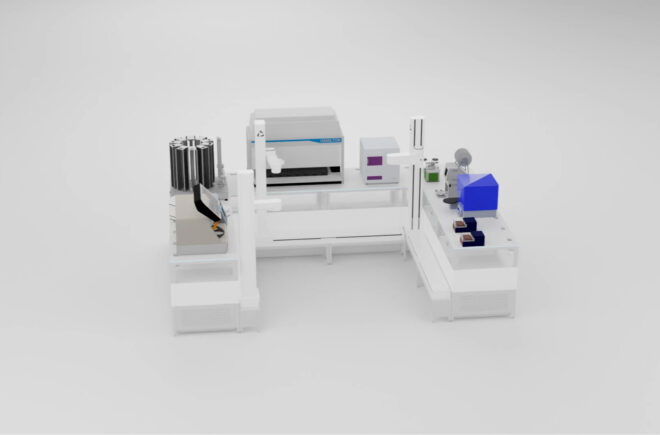
Automata, recognized for its easy-to-use industrial robots
Acknowledging the complex and repetitive tasks common in biolabs, Automata applied its automation expertise to create solutions that boost productivity and precision in these environments.
FAQ.
How long does it take to implement a CPQ solution for an automotive company?
The timeline depends on product complexity, integrations, 3D data, pricing logic, and approval workflows. A focused CPQ implementation can take a few months, while large-scale automotive projects with ERP, CRM, PLM, dealer systems, and advanced visualization usually require a phased rollout.
What factors influence the cost of custom CPQ software for automotive businesses?
Key cost drivers include the number of product variants, technical rules, pricing models, 3D or AR visualization, customization, system integrations, user roles, markets, languages, and required workflows. The more complex the product and sales process, the more effort is needed for configuration, testing, and maintenance.
Is CPQ software suitable for both direct and dealer-based automotive sales?
Yes. CPQ software can support direct sales, dealer networks, partner portals, and online channels. It helps keep product logic, pricing rules, availability, and quote data consistent across all sales touchpoints.